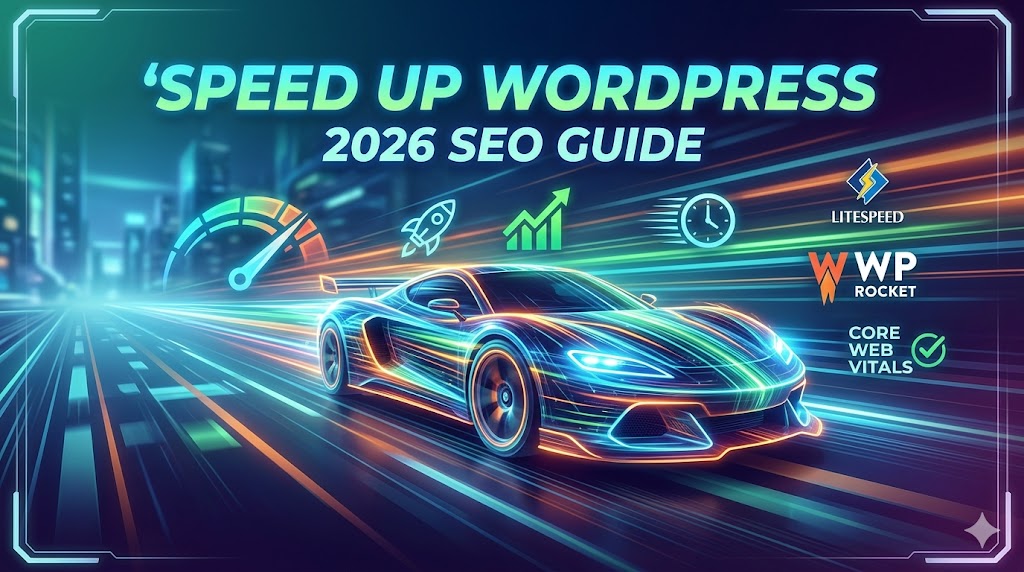
Is your WordPress website loading slower than a snail? In 2026, page speed is no longer just a luxury—it’s a critical Google ranking factor. According to recent data, a delay of even one second can reduce your conversions by 20%.
If you want to provide a seamless user experience and dominate the search engine result pages (SERPs), you need a site that loads in under 2 seconds. In this guide, I will share the most effective, proven strategies for WordPress Speed Optimization.
The foundation of a fast website is your hosting provider. No matter how many plugins you use, a slow server will always bottleneck your performance. For 2026, we recommend using Cloud-managed or NVMe-based hosting.
Internal Link Gap: If you have a post about hosting reviews, link it here: [Insert Link to Your Hosting Review Post]
Avoid multi-purpose themes that come bloated with unnecessary features and heavy code. Stick to minimalist, performance-first themes like GeneratePress, Astra, or Hello Elementor.
Internal Link Gap: To see our top recommended themes, check out: [Insert Link to Your Best Themes Post]
Caching creates a static version of your site to reduce server processing time.
LiteSpeed Cache: Best if your host uses a LiteSpeed server.
WP Rocket: The gold standard for beginners using Apache or Nginx servers.
Object Cache (Redis/Memcached): Essential for database-heavy sites like eCommerce.
Images are often the heaviest part of a webpage. In 2026, JPEG is officially outdated.
Use AVIF Format: It offers 50% better compression than JPEG without losing quality.
Enable Lazy Loading: This ensures images only load when they appear in the user’s viewport.
Internal Link Gap: For a list of the best image compression tools, visit: [Insert Link to Your Image Optimization Tools Post]
Google’s Core Web Vitals are the metrics that define a “good” user experience. To pass the 2026 audit, focus on:
LCP (Largest Contentful Paint): Optimize your hero images.
INP (Interaction to Next Paint): Minimize main-thread work by reducing heavy JavaScript.
CLS (Cumulative Layout Shift): Always define width and height for images to prevent layout jumps.
Speeding up your WordPress site is an ongoing process of optimization and monitoring. By following the steps above—upgrading your hosting, optimizing images, and mastering caching—you will see a significant boost in both your traffic and rankings.
Ready to boost your speed? Run a test on PageSpeed Insights and share your current score in the comments below!